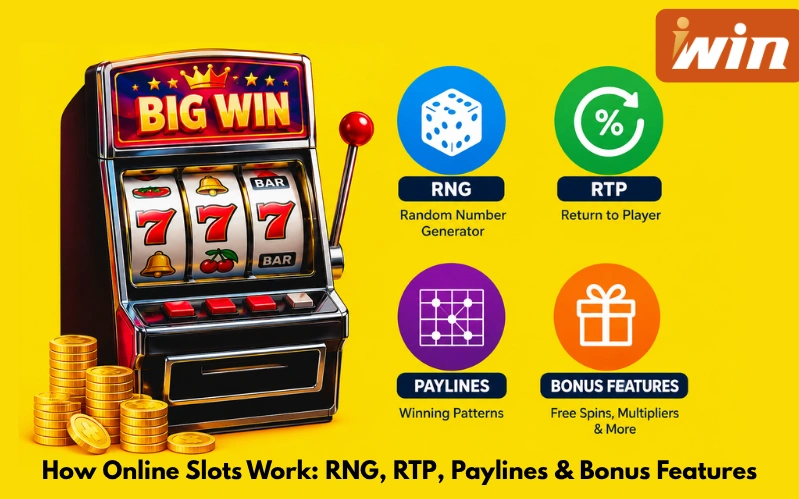
Online slots are among the most widely played casino games because the basic idea is simple: choose your bet, spin the reels, and check whether the resulting symbols create a winning combination. However, the technology and mathematics behind online slots are more detailed than the spinning animation suggests. Understanding how online slots work means looking at several connected elements, including the Random Number Generator (RNG), RTP, volatility, reels, symbols, paylines, paytables, ways-to-win systems, and bonus features. This guide explains how online slots work, what happens during a spin, how winning combinations are evaluated, and what terms such as slot RNG, RTP slots, slot volatility, Wilds, Scatters, and Free Spins actually mean.
How Do Online Slots Work?
At a basic level, an online slot generates a game outcome when the player starts a spin. The result then appears on the game’s virtual reels or in another visual format.
The general process looks like this:
Bet → Spin → RNG generates an outcome → Reels display symbols → Winning combinations are evaluated → Paytable determines the payout
The important point is that the spinning reels are mainly a visual representation of the underlying game result. The game’s mathematical and technical system, not the visual animation, determines the outcome.
Modern online slot mechanics can vary significantly between games. Some use traditional paylines, while others use ways-to-win, cluster pays, cascading reels, or other systems.
What Happens When You Spin an Online Slot?
This process happens quickly, letting the player see the result almost immediately. When you press the Spin button, several things happen within a very short period.
1. A Bet Is Selected
Before spinning, the player chooses a wager within the game’s available betting range.
Different slots can have different minimum and maximum bet levels.
2. The Spin Is Initiated
Pressing Spin starts the game round. At this point, the game’s RNG system generates the outcome according to the programmed mathematical model.
3. The RNG Determines the Result
The Random Number Generator, commonly called an RNG, produces a random or pseudorandom value that the game’s software uses to determine the result.
4. The Result Is Mapped to the Reels
The generated result corresponds to a particular combination of symbols or positions within the game’s reel or grid structure.
5. Winning Combinations Are Checked
The game evaluates the resulting symbols according to its rules. Depending on the slot, this could involve paylines, ways to win, cluster pays, or another winning system.
6. The Paytable Determines the Payout
If the resulting combination qualifies for a payout, the game uses its paytable and applicable rules to calculate the amount.
What Is RNG in Slots?
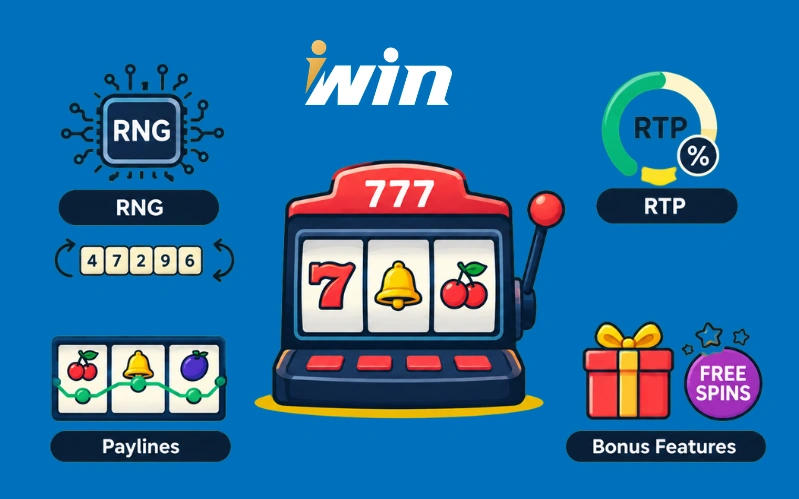
RNG stands for Random Number Generator. It is one of the most important technologies used in modern online slots. The slot RNG generates the numerical results that determine game outcomes. In regulated gaming environments, RNG systems are generally designed and tested to produce outcomes according to the game’s documented mathematical model.
For example, a simplified process could be:
RNG result → Reel positions → Symbol combination → Win evaluation
The actual mathematics used by commercial games can be considerably more complex than this simplified example.
Does RNG Determine Every Slot Spin?
Yes. Each spin is treated as a separate game event.
A previous losing spin does not automatically make the next spin more likely to win, and a previous winning spin does not automatically make the next spin more likely to lose.
This is an important part of understanding how slot RNG works.
Are Online Slots Random?
Online slots are designed to produce outcomes according to their programmed RNG and mathematical models. The exact implementation can vary by provider and jurisdiction. Players should understand that individual spins generally cannot be predicted simply by looking at previous results.
What Is RTP in Slots?
RTP, or Return to Player, is a theoretical percentage that describes how much of the total amount wagered a slot is mathematically designed to return over a very large number of plays. For example, a slot with a theoretical RTP of 96% is designed to return 96 units for every 100 units wagered over a sufficiently large sample. This does not mean a player will receive exactly 96% of their money back during an individual session.
What Does 96% RTP Mean?
A 96% RTP means that the game’s theoretical long-run return is 96%.
The remaining 4% represents the theoretical difference between total wagers and the game’s expected return, often described as the house edge.
However, RTP is a long-term statistical measure and does not predict the outcome of a particular spin.
Does RTP Affect Every Spin?
No.
Don’t interpret RTP as a fixed percentage applied to every spin.
One player might experience a series of wins, while another player might experience a series of losses. Over a sufficiently large number of game outcomes, the mathematical model is designed to approach its theoretical RTP.
Does Higher RTP Guarantee Winnings?
No.
A higher theoretical RTP does not guarantee that an individual player will win or that a particular session will be positive.
RTP is best understood as a long-term mathematical characteristic of a slot, not a promise of short-term returns.
What Is Slot Volatility?
Slot volatility describes the general distribution of payouts within a game’s mathematical model.
It is different from RTP. Two games can have a similar RTP but very different volatility profiles.
- Low-Volatility Slots
Low-volatility slots generally tend toward more frequent but smaller payouts. This does not mean that every session will contain frequent wins, because individual results remain random.
- Medium-Volatility Slots
Medium-volatility games sit between lower- and higher-volatility models, offering a balance in the general distribution of wins and payouts.
- High-Volatility Slots
High-volatility slots generally feature less frequent payouts with the possibility of larger individual wins. Again, volatility does not predict what will happen on the next spin.
RTP vs Volatility
Understanding all three provides a clearer picture of online slot mechanics. RTP and volatility answer different questions:
- RTP: What is the game’s theoretical long-term return?
- Volatility: How are payouts generally distributed?
- RNG: How is each game outcome generated?
What Are Paylines in Online Slots?
Paylines are predetermined patterns that determine which symbol combinations can create winning results. A traditional slot may have a specific number of fixed paylines running across its reels. For example, a five-reel game might use horizontal, diagonal, or other predefined patterns.
How Do Paylines Work?
The game checks the symbols appearing along the active paylines in slots. If the required combination of matching symbols appears according to the game’s rules, the player may receive a payout. The exact requirements differ between games, so players should always check the individual game’s paytable.
Fixed and Adjustable Paylines
Some slots use fixed paylines, meaning you can’t change the number of active lines. Other games may allow players to select the number of paylines or adjust their wager per line.
Do More Paylines Mean Better Results?
Adding more paylines can increase the number of active winning patterns, but it can also increase the total wager depending on the game’s betting system. More paylines should not be interpreted as a guarantee of winning.
What Are Wild Symbols?
Wild symbols are special symbols that can substitute for other symbols in certain winning combinations. Their exact function depends on the game.
Some slots may include different types of Wilds, such as:
- Expanding Wilds
- Sticky Wilds
- Walking Wilds
- Stacked Wilds
- Random Wilds
A Wild symbol does not necessarily substitute for every symbol. Check the paytable to understand exactly how the Wild works in a particular game.
What Are Scatter Symbols?
Scatter symbols are special symbols that usually have different rules from standard symbols. In many slots, Scatters can trigger bonus features or Free Spins.
Depending on the game, Scatters may:
- Trigger Free Spins
- Provide a direct payout
- Activate a bonus round
- Unlock special features
- Work independently of traditional paylines
A Scatter doesn’t always need to appear on an active payline, but that depends entirely on the game’s rules.
How Do Free Spins Work?
Free Spins are bonus rounds in which players receive a specified number of spins without paying the standard base-game stake for each spin. They can be triggered in different ways, often by landing a required number of Scatter symbols.
During a game, it may introduce additional mechanics such as:
- Multipliers
- Sticky Wilds
- Expanding Wilds
- Additional Scatters
- Retriggers
- Special reel configurations
Other Additional Online Slot Bonus Features
Modern online slots can include many different slot bonus features designed to add additional gameplay mechanics.
1. Bonus Rounds
Bonus rounds provide gameplay beyond the standard reel sequence.
They may include:
- Pick-and-win games
- Interactive mini-games
- Free-spin rounds
- Mystery features
- Special bonus modes
- Multiplier rounds
Some bonus rounds require specific symbols or combinations to activate, while others may be triggered through a dedicated feature symbol.
2. Slot Multipliers
Slot multipliers increase a qualifying payout by a specified value. The multiplier’s exact effect depends on the individual game’s rules.
For example, a game could feature:
- 2x
- 3x
- 5x
- 10x
- Higher special multipliers
Some multipliers may appear during normal gameplay, while others may be restricted to bonus rounds.
3. Cascading Reels
Cascading reels, also called tumbling reels in some games, remove qualifying winning symbols and replace them with new symbols. This can allow additional winning combinations to form during the same game sequence.
Depending on the title, cascading mechanics may be combined with:
- Multipliers
- Free Spins
- Wilds
- Expanding symbols
- Bonus features
4. Progressive Jackpots
Some slots include progressive jackpots. In a progressive jackpot system, the jackpot value can increase over time according to the game’s rules until the qualifying jackpot is won. Not every online slot has a progressive jackpot, and jackpot conditions vary by game.
How Online Slots Determine Winning Combinations
Once the RNG has generated the game outcome, the slot evaluates the resulting reel or grid configuration. The game then checks whether the symbols meet its winning conditions.
For a traditional payline slot, the process could be:
RNG result → Reel symbols → Active paylines → Matching combination → Paytable → Payout
For a ways-to-win slot, the process may instead involve:
RNG result → Reel symbols → Adjacent matching symbols → Ways-to-win calculation → Payout
For a cluster-pay game, the game may check whether enough matching symbols appear together according to its cluster rules. That is why understanding each game’s rules matters.
How Slot Odds and Probability Work
Slot odds are often misunderstood because no single universal probability applies to every online slot. Each game has its own mathematical model, RTP, volatility, reel configuration, symbol distribution, and feature rules. A slot’s RTP provides a long-term theoretical return, but it does not tell you the probability of winning on the next spin. Similarly, volatility describes the general distribution of payouts but can’t predict a particular result.
Are Online Slots Random?
Online slots using RNG technology are designed so that individual game outcomes are generated according to the game’s programmed mathematical model. The important distinction is between random individual outcomes and long-term mathematical characteristics.
- RNG controls the individual outcome.
- RTP describes the theoretical long-term return.
- Volatility describes the general distribution of payouts.
- These concepts work together but should not be confused with one another.
Common Myths About How Do Slots Work?
Several misconceptions surround online slot games.
Myth 1: A Slot Is Due for a Win
A series of losing spins does not automatically mean that the next spin is due to win.
Myth 2: A Big Win Makes the Next Spin Colder
A previous large payout does not automatically determine the next outcome.
Myth 3: RTP Guarantees a Return
RTP is a percentage and does not guarantee a specific return during an individual session.
Myth 4: High Volatility Means More Winning Spins
High volatility does not mean a player will win more frequently. It describes the general distribution of payouts.
Myth 5: Players Can Predict the Next Spin
Previous results, betting patterns, or timing generally cannot be used to reliably predict the next RNG-generated outcome.
How to Read an Online Slot Before Playing
Before playing an online slot, review the game’s information and paytable. Pay attention to:
- RTP
Check the game’s published theoretical RTP where available.
- Volatility
Understand whether the game is described as low, medium, or high volatility.
- Paylines or Win System
Check whether the game uses traditional paylines, ways to win, cluster pays, or another system.
- Symbols
Learn what regular, Wild, Scatter, and bonus symbols do.
- Bonus Features
Review the rules for Free Spins, multipliers, jackpots, and other special features.
- Betting Limits
Check the minimum and maximum available wagers.
- Jackpot Conditions
If the game has a jackpot, review the conditions required to qualify and how the jackpot is awarded.
How to Understand an Online Slot in Simple Terms
For beginners, the entire process can be simplified into five main stages:
- Choose a Game
Select a slot and review its rules, paytable, RTP, volatility, and betting limits.
- Select Your Bet
Choose a stake within the game’s available range.
- Start the Spin
Press Spin to initiate the game round.
- RNG Generates the Outcome
The RNG determines the outcome based on the game’s mathematical model.
- The Game Evaluates the Result
The game checks the symbols against its paylines, ways-to-win, cluster rules, or other mechanics. If the result qualifies for a payout, the game applies the relevant paytable and bonus rules.
This is the basic answer to how online slots work.
Responsible Online Slot Play
Understanding how online slots work is useful, but it does not remove the financial risk associated with gambling.
Players should:
- Set a personal spending limit.
- Treat slots as entertainment, not guaranteed income.
- Avoid chasing losses.
- Take regular breaks.
- Understand the game’s rules before playing.
- Never spend money intended for essential expenses.
- Stop playing if gambling is becoming difficult to control.
RTP, volatility, RNG, and bonus features explain how a game operates, but none of them guarantee a profit.
Final Takeaway
The mechanics behind online slots can be summarized through several key components. The RNG determines each game’s outcome. The reels and symbols display that outcome. Paylines, ways to win, or cluster systems determine how the game evaluates winning combinations. The paytable explains symbol values and payout rules. RTP describes the game’s theoretical long-term return, while volatility describes the general payout distribution.
Bonus mechanics such as Wilds, Scatters, Free Spins, Multipliers, Cascading Reels, Bonus Rounds, and Progressive Jackpots can add additional gameplay features depending on the title. Understanding these concepts makes it easier for beginners to read slot information, compare different games, and understand what happens when they press the Spin button.
Frequently Asked Questions
Are online slots random?
RNG-based online slots are designed to generate individual outcomes according to their programmed mathematical model. Previous spins do not normally determine the next spin.
Does 96% RTP mean I will get 96% back?
No. A 96% RTP represents a long-term theoretical return. It does not guarantee that an individual player or session will receive 96% of their wagered money back.
What is a ways-to-win slot?
A ways-to-win slot uses adjacent reels and matching symbols to create winning combinations instead of relying on traditional fixed paylines.
What is a slot paytable?
A slot paytable provides information about symbol values, winning combinations, Wilds, Scatters, bonus features, and other game rules.
Can previous spins affect the next spin?
In an RNG-based slot, previous results do not normally determine the next outcome. Each game round is generated according to the game’s mathematical and RNG system.
Can you predict the outcome of an online slot?
You generally can’t predict individual RNG-generated slot outcomes by studying previous spins, betting patterns, or whether a machine appears to be “due.”