
Online casino myths in Malaysia often involve game fairness, winning strategies, random number generators (RNG), return to player (RTP), bonuses, and gambling laws. Some people believe a losing streak means a win is coming, while others assume increasing a bet or following a specific strategy can guarantee profits. These beliefs can create unrealistic expectations about how online casino games work. Understanding the facts can help readers recognize misleading claims, understand gambling risks, and evaluate online platforms more carefully. In this guide, we explain common online casino myths and facts, how RNG and RTP work, what casino fairness testing means, how to recognize potential scams, and what to consider when reading about gambling laws in Malaysia.
Important: This article provides general educational information, not legal or financial advice. Malaysian gambling laws can depend on the activity and applicable legislation. Readers should consult current official sources or a qualified legal professional for advice about a specific situation.
Why Are There So Many Myths About Online Casinos?
Online casino myths keep spreading for several reasons. Some stem from misunderstandings about probability, while others arise from personal experiences, misleading ads, or unverified online claims.
1. Lack of Understanding About Casino Technology
Terms such as random number generator (RNG), RTP, volatility, and house edge can be difficult to understand without a basic explanation. When players experience unexpected results, they may assume that the game has been manipulated.
However, an unusual result does not automatically prove that a game is unfair. The game’s rules, mathematical design, software implementation, and applicable testing arrangements all matter when assessing fairness.
2. Misleading Casino Promotions
Some gambling promotions use phrases such as “easy wins,” “big rewards” or “exclusive winning opportunities.” These claims can create unrealistic expectations, especially when important bonus conditions are less prominent than the promotional message.
A bonus does not remove the financial risks of gambling, and promotional language should not be treated as evidence of a likely profit.
3. Personal Experiences Can Create False Beliefs
A player who loses several times in a row may believe that a win is now more likely. Someone who wins after increasing a bet might assume that the larger wager caused the result.
Individual experiences can feel convincing, but they do not establish a reliable pattern. Probability should be understood through the game’s mathematical rules rather than isolated results.
4. Online Rumors Spread Quickly
Social media posts, videos, forums, and private groups can spread claims about secret winning methods, lucky games, and guaranteed payouts. Repeated claims can seem credible even without reliable evidence.
Checking a claim’s original source is more useful than relying on popularity or testimonials alone.
Top Online Casino Myths vs Facts
The following online casino myths cover common misconceptions about fairness, slot results, betting strategies, bonuses, and withdrawals.
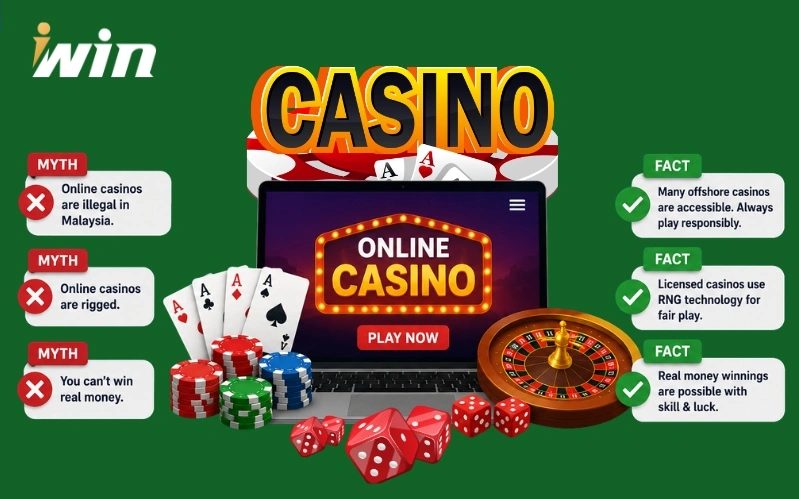
Myth 1: Online Casinos Are Always Rigged
Myth: Every online casino game is designed to cheat players.
Fact: It is not accurate to assume that every online casino game is rigged. Properly developed casino games use defined mathematical rules and, for RNG-based games, randomization systems to determine outcomes.
Some games and operators are subject to independent testing, certification or regulatory requirements. However, these safeguards vary, and you should not automatically accept a website’s claims as proof of fairness.
When evaluating a platform, check the operator’s identity, relevant licensing information, game provider, published rules, and available evidence of testing. A professional-looking website alone doesn’t prove its games are trustworthy.
Myth 2: Online Casinos Can Change Every Result Whenever They Want
Myth: A casino can manually change any slot spin or card result whenever it chooses.
Fact: In a properly implemented RNG game, the game’s software and randomization process generate outcomes. Whether a specific game meets its stated requirements depends on its implementation and the relevant controls or testing.
Players generally cannot establish that a game has been manipulated simply because they experienced several losses or received a smaller payout than expected.
If a result appears inconsistent with the published rules, review the paytable and game terms, keep relevant transaction records, and use the operator’s formal complaint process where appropriate. Do not assume that a license badge or an operator’s own assurance is conclusive evidence.
Myth 3: A Losing Streak Means a Win Is Coming
Myth: After several losing spins, the next spin is more likely to produce a win.
Fact: This belief is known as the gambler’s fallacy. In an independent RNG-based game, previous outcomes do not automatically make the next outcome more likely to win.
For example, ten losing spins do not mean that an eleventh spin is due to produce a winning combination. The outcome still depends on the game’s mechanics and probability model.
Increasing your stake or continuing to play to recover previous losses does not eliminate this risk. A losing streak should not be treated as a prediction of future results.
Myth 4: Previous Results Can Predict the Next Spin
Myth: Looking at previous slot results reveals which symbols or combinations will appear next.
Fact: Previous results from independent RNG outcomes generally cannot reliably predict the next spin.
A sequence of similar symbols or repeated results can seem meaningful, but randomness can produce short-term patterns that aren’t predictive.
Game history may help you review past activity where available, but it shouldn’t be treated as a reliable way to forecast future outcomes.
Myth 5: Betting More Increases Your Chance of Winning
Myth: A larger bet makes a winning outcome more likely.
Fact: Increasing the stake does not automatically improve the probability of an outcome in a game whose underlying odds remain unchanged.
A larger wager may increase the monetary value of a potential payout, but it can also increase the amount lost. The actual payout depends on the game rules, the wager and the result.
Bet size should therefore be considered in relation to affordability, not as a method of making a game more favorable.
Myth 6: A Betting Strategy Can Guarantee Casino Profits
Myth: A secret system or betting progression can guarantee consistent winnings.
Fact: No betting system can guarantee profits in casino games.
Some strategies help players understand game rules, organize wagers, or manage a budget. They do not remove the underlying uncertainty or eliminate the house edge in games where one applies.
Systems that recommend doubling bets after losses, following rigid betting sequences or using supposed winning signals can expose players to larger losses.
Casino gambling should not be treated as a dependable source of income. Avoid strategies that encourage borrowing money, chasing losses, or wagering beyond an affordable limit.
Myth 7: Online Slots Are Not Truly Random
Myth: Slot games are programmed to decide exactly when a player should win.
Fact: RNG-based slots use randomization systems to generate outcomes according to their programmed game design. Assess how a particular game operates by its rules, software implementation, and applicable testing arrangements.
Different slots can have different RTP values, volatility levels, paylines, and bonus mechanics. These differences affect how the games are designed and how their theoretical payouts or result distributions are described.
However, they don’t reliably predict the result of an individual spin. A slot appearing to be “hot” or “cold” is not evidence that its next outcome can be forecast.
Myth 8: RTP Means You Will Get Your Money Back
Myth: A slot with 96% RTP guarantees that every player will receive RM96 for every RM100 wagered.
Fact: Return to player (RTP) is a theoretical percentage calculated over a large number of game rounds. It is not a guarantee of an individual player’s return during a session.
For example, a slot advertised with 96% RTP has a theoretical return of RM96 per RM100 wagered over the relevant long-run calculation, subject to the game’s stated model. It does not mean that every RM100 deposit or session will return RM96.
Individual results can differ substantially from the theoretical percentage. Players may receive less, receive more, or lose their entire session budget. RTP is a mathematical characteristic of a game, not a promise of personal earnings.
Myth 9: Casino Bonuses Are Free Money
Myth: A casino bonus is cash that can be withdrawn immediately without restrictions.
Fact: Casino bonuses may come with conditions that affect eligibility, wagering and withdrawals. The exact terms depend on the promotion and operator.
Before accepting a bonus, check:
- Wagering requirements: How much qualifying wagering, if any, is required.
- Eligible games: Which games count towards the requirements.
- Expiry dates: When the bonus or related balance expires.
- Maximum withdrawal limits: Whether a cap applies to promotional winnings.
- Betting restrictions: Whether limits apply while a bonus is active.
- Eligibility rules: Whether particular accounts, payment methods or deposits qualify.
- Withdrawal conditions: Whether verification or other requirements must be completed.
A promotional headline may not explain every condition. Read the full terms before deciding, and don’t deposit money solely because a bonus is advertised as generous.
Myth 10: Playing Longer Improves Your Chances of Winning
Myth: If you continue playing long enough, you will eventually recover your losses or secure a win.
Fact: Playing for longer does not guarantee a positive result.
Longer sessions can involve more wagers, which may increase the total amount exposed to the game’s mathematical advantage. No general rule says continued play will eventually produce a profit.
Setting a spending limit and a time limit before gambling can help prevent a session from continuing simply because you want to recover earlier losses. If you reach your limit, stop instead of treating more play as a solution.
Myth 11: Live Casino Games Are Always Fairer Than Online Slots
Myth: Live dealer games are automatically fairer because a real person handles the cards or equipment.
Fact: Live casino games and RNG-based games use different methods to generate results, but neither format should be considered trustworthy solely because of how it looks.
Live games may involve physical cards, wheels, dealing procedures, and video streams. RNG games rely on software to generate outcomes. When assessing either format, the relevant rules, operational controls, testing, and oversight matter.
A live video feed alone does not prove that an operator follows fair procedures. Similarly, digital graphics alone do not prove that an online casino game is manipulated.
Myth 12: Online Casinos Always Pay Every Winner
Myth: Every website that calls itself an online casino will reliably process every withdrawal.
Fact: Players should not assume that all gambling websites are trustworthy or that every withdrawal will be completed without problems.
Withdrawal outcomes and processing times can depend on account verification, payment methods, transaction limits, published terms, and operator procedures. Some platforms may also make misleading claims or create barriers to withdrawals.
Before providing financial or personal information, investigate the operator and review its withdrawal policy. If a website makes unexpected payment demands or refuses to explain its procedures, proceed with caution.
Read our guide to online casino scams in Malaysia for more information about potential warning signs.
Common Slot Myths About Luck, Timing and Patterns
Some casino myths focus specifically on luck and slot machine behavior. These beliefs often arise when players try to interpret random outcomes as signals about what will happen next.
Myth: A Hot Slot Is More Likely to Pay Out
Fact: A slot that has recently paid out is not necessarily more likely to pay out again. Past outcomes do not establish that the game has entered a predictable winning period.
Myth: A Cold Slot Is Due for a Big Win
Fact: A series of losses does not mean that a jackpot or winning combination is due. Continuing to play because a slot hasn’t paid recently can encourage you to chase losses.
Myth: Pressing Spin at the Right Time Changes the Result
Fact: In a properly functioning RNG game, button-press timing does not reliably predict or control the outcome. Follow the game’s actual rules rather than claims about special timing techniques.
Myth: Lucky Numbers or Rituals Improve Casino Odds
Fact: Personal rituals, favorite numbers, and lucky symbols don’t automatically change a game’s mathematical probabilities. In games with defined rules, outcomes depend on those rules and the mechanism that generates them.
RTP, House Edge and Casino Fairness
Understanding RTP and house edge helps explain why a game can follow its published rules while still giving players a financial disadvantage.
What Is the House Edge?
The house edge is the theoretical mathematical advantage a casino game has over players over the long run.
It describes the expected difference between what you wager and what the game’s mathematical model returns. It does not predict what will happen in a short session or to a particular player.
How Are RTP and House Edge Different?
RTP expresses the theoretical proportion of wagers returned to players over the relevant long-run calculation. House edge describes the corresponding theoretical advantage the house retains.
For example, in a simplified game with a theoretical RTP of 96%, the corresponding house edge would be 4%, assuming both figures describe the same game model and calculation basis.
This relationship does not mean that every session produces a 4% loss. Individual outcomes vary, and actual results can be very different from long-run expectations.
Why Fairness Does Not Guarantee a Win
Fairness and profitability are separate questions.
A game may follow its published rules and use an appropriately tested randomization system while still having a house edge. Testing may help assess whether software and game mathematics meet specified requirements, but it does not guarantee that a player will win or that every website making a fairness claim is legitimate.
For additional context, consult the UK Gambling Commission’s guidance on game testing and its RTP calculation guidance. These are examples of regulatory guidance and should not be taken as proof that the same requirements apply to every operator serving Malaysian users.
Online Casino Legality in Malaysia: What Players Should Know
The legal position of online gambling in Malaysia should not be reduced to a blanket statement that every operator or activity has the same status. Relevant considerations can include the specific activity, the parties involved, and the applicable Malaysian legislation.
This article is not a substitute for legal advice. If you need to understand whether a particular gambling activity is permitted, consult current official legal sources or a qualified professional.
Why Gambling Law Can Be Complex
Questions about gambling can involve different legal provisions and circumstances. Relevant considerations may include:
- The type of gambling activity.
- Whether the activity is conducted online or at a physical venue.
- The identity and location of the operator.
- The applicable federal or state provisions.
- The circumstances in which the service is offered or accessed.
Readers should not assume that a statement about one type of gambling automatically applies to every other activity.
What Does an Online Gambling Licence Mean?
A gambling licence generally refers to authorization issued by a particular regulatory authority for specified activities and under defined conditions.
When checking a licence claim, consider these questions:
- Which authority supposedly issued the licence?
- Does the licence number correspond to a verifiable record?
- Does the named company match the actual operator?
- What activities and conditions does the license cover?
- Does the authorization establish permission to serve customers in the relevant jurisdiction?
A license from another country does not, by itself, authorize an operator to provide gambling services in Malaysia. Logos, badges, and copied license details should be independently verified wherever possible.
How to Identify Fake or Unsafe Online Casinos
Understanding online casino myths is only part of evaluating a gambling website. Readers should also consider how an operator identifies itself, explains its policies and handles personal or financial information.
1. Check Licensing Information
Look for the issuing authority, licence number, named operator and scope of authorization. Verify the information using the relevant regulator’s official records where available.
Do not rely exclusively on a badge displayed on the website.
2. Verify the Operator
Check whether the website clearly identifies the company responsible for the service and provides consistent contact and business information. Missing or inconsistent information may make it harder to identify who operates the platform or where to direct complaints. Investigate such issues before sharing sensitive information.
3. Review Payment and Withdrawal Rules
Before making a deposit, review the site’s published payment and withdrawal policies. Check:
- Supported payment methods.
- Minimum and maximum transaction amounts.
- Verification requirements.
- Withdrawal procedures and stated processing times.
- Transaction limits and applicable fees.
- Conditions that could affect withdrawal eligibility.
Our guide to online gambling regulations provides related information, but readers should verify legal and regulatory details against current official sources.
4. Understand Website Security
HTTPS helps encrypt information transmitted between a browser and a website. However, HTTPS alone does not establish that a website is legitimate or that its operator is trustworthy.
Also review the privacy policy, account security options, document submission procedures and information about payment processing.
Avoid sending identity documents, account credentials or payment information through unverified channels.
5. Look for Responsible Gambling Tools
Where gambling services are legally available, tools such as deposit limits, spending controls, session reminders and self-exclusion options may help users manage their activity.
The availability of these features does not, by itself, prove that an operator is trustworthy. Consider them alongside the operator’s identity, policies, and applicable regulatory status.
6. Be Cautious of Unrealistic Promises
Treat the following claims as warning signs that require scrutiny:
- Guaranteed casino profits.
- Risk-free gambling.
- Secret methods that always win.
- Guaranteed jackpot strategies.
- Claims that losses can always be recovered.
- Pressure to deposit immediately to unlock a supposed reward.
No legitimate betting system can eliminate the uncertainty and financial risks associated with casino games.
Fake Online Casino Reviews and Misleading Claims
Reviews can help readers learn about an operator, but they should not be treated as conclusive evidence of fairness, safety, or reliable withdrawals.
How Can You Recognize Potentially Misleading Reviews?
Look for patterns such as:
- Multiple reviews repeating nearly identical promotional language.
- Testimonials without verifiable details or supporting evidence.
- Screenshots of winnings that cannot be independently authenticated.
- Reviews that discuss bonuses but ignore withdrawal conditions.
- Claims that a website is guaranteed to pay or produce profits.
These signs alone do not prove a review is fake. Consider the overall evidence and compare claims with independent information where available.
Why Should You Verify Casino Claims Independently?
A promotional website may have an incentive to encourage registrations or deposits. This does not automatically make its claims false, but it means readers should distinguish advertising from independent verification.
Check operator details, published game rules, license records where relevant, and withdrawal terms rather than relying solely on testimonials.
Withdrawal Delays: When Should You Be Cautious?
A delayed withdrawal does not automatically prove that a casino is fraudulent. At the same time, don’t accept a website’s explanation without question if its policies or demands seem inconsistent.
What Can Cause a Withdrawal Delay?
Possible reasons include identity verification, payment-provider processing, incomplete account information, transaction limits or additional account checks. The relevant explanation depends on the operator and payment method.
Review the stated withdrawal policy and retain records of transactions and communications.
What Are Potential Warning Signs?
Be cautious if a platform:
- Repeatedly changes its stated withdrawal conditions.
- Provides no clear explanation for an unresolved transaction.
- Makes unexpected demands for additional payments to release funds.
- Requests sensitive information through unofficial channels.
- Cannot provide verifiable information about the responsible operator.
These warning signs deserve investigation, although they do not, on their own, establish what happened in a particular case. Avoid sending additional money simply because someone promises that it will unlock a withdrawal.
Responsible Gambling Is Essential
Understanding online casino facts also means recognizing that gambling carries financial risks. No strategy guarantees a profit or ensures you’ll recover losses.
Consider these precautions:
- Set a firm spending limit before gambling.
- Only use money you can afford to lose.
- Set a time limit and take regular breaks.
- Do not chase losses or increase bets to recover money.
- Avoid borrowing money to gamble.
- Do not treat gambling as a way to solve financial problems.
- Stop if gambling begins to affect your finances, relationships, work or daily responsibilities.
If gambling becomes difficult to control, consider taking a break and seeking appropriate support. Protecting your wellbeing is more important than continuing to play.
Final Takeaway
Online casino myths in Malaysia often arise from misunderstandings about probability, RNG technology, RTP, betting strategies, bonuses, and gambling laws. Separating myths from facts helps readers understand the limitations of casino games and recognize potentially misleading claims.
Remember these key points
- Previous results do not guarantee future outcomes.
- Losing streaks do not mean that a win is due.
- RTP is a theoretical long-term measure, not a personal payout guarantee.
- No betting system can guarantee profits.
- Bonuses may have conditions that affect their use and withdrawal.
- A foreign license does not automatically establish authorization to operate in Malaysia.
- Verify reviews, security badges, and promotional claims rather than accepting them at face value.
- Gambling involves financial risk and should never be treated as a reliable source of income.
The best approach is to rely on verifiable information, understand the risks, and check claims carefully. No website, game, or strategy can guarantee that gambling will result in a profit.
Frequently Asked Questions
Are online casinos legal in Malaysia?
The legal position depends on the specific activity and applicable legislation. Do not assume that a foreign gambling license automatically authorizes an operator to provide gambling services in Malaysia. Consult current official sources or a qualified legal professional for advice about a specific situation.
Are online casino games rigged?
Not every online casino game is rigged. RNG-based games use randomization systems, and some games are independently tested or certified. However, players should verify the relevant game, operator, and available evidence rather than relying on unsupported claims.
Can online casinos manipulate game results?
Whether a particular game meets its stated requirements depends on its software, implementation and applicable controls. Players cannot establish manipulation solely from a losing streak or an unexpected outcome. Review the published rules and use formal complaint procedures if there is a specific, evidence-based concern.
Does a losing streak mean a win is coming?
No. A losing streak does not automatically make the next independent RNG outcome more likely to win. Continuing to play or increasing your stake to recover losses does not guarantee a better result.
Can previous slot results predict the next spin?
Previous outcomes generally cannot reliably predict the next independent RNG spin. Patterns may appear in random results, but they don’t necessarily predict what will happen next.
What is the biggest myth about online casinos?
One of the most harmful misconceptions is that a secret betting system can guarantee profits. Casino games involve probability and financial risk, and no legitimate strategy can guarantee consistent winnings.
Does a 96% RTP mean I will get 96% of my money back?
No. A 96% RTP is a theoretical long-run return figure under the game’s mathematical model. It doesn’t guarantee an individual player will get 96% of their wagers back during a session.
Are casino bonuses really free money?
Not necessarily. Bonuses may have wagering requirements, expiry dates, eligible-game restrictions, and withdrawal conditions. Read the complete terms before accepting an offer, and do not assume that a promotional balance can be withdrawn immediately.
Do online casinos always pay winnings?
No such guarantee should be assumed for every website. Withdrawal outcomes can depend on verification, payment processing, published terms and operator procedures. Investigate the operator and review its policies before providing financial information.
What should I check before trusting an online casino?
Review the operator’s identity, relevant licensing information, published game rules, privacy policy, payment and withdrawal terms, and available evidence of testing. Be cautious of guaranteed-profit claims and requests for unexpected payments.
How can I avoid online casino scams in Malaysia?
Do not rely solely on promotional claims, reviews, or license badges. Verify available information independently, understand the risks, protect your personal and financial data, and consider the relevant Malaysian legal context before taking any action.