
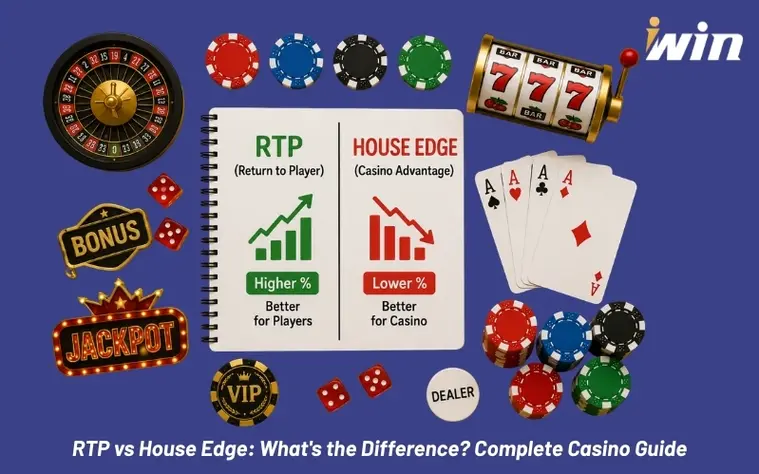
Understanding RTP vs house edge matters for anyone who wants to understand the math behind casino games. These two terms are often used together because both describe a casino game’s expected financial characteristics, but they look at the subject from different perspectives. RTP (Return to Player) describes the theoretical percentage of wagers a game returns to players over a very large number of plays. House edge represents the casino’s theoretical mathematical advantage over players. This guide explains RTP and house edge, how they are calculated, how they apply to online slots and table games, and why understanding both metrics can help you interpret casino-game information more accurately.
What Is RTP in Casino Games?
RTP, or Return to Player, is a percentage used to describe the theoretical long-term return of a casino game. When a game has an RTP of 96%, the mathematical model indicates that approximately RM96 would theoretically be returned for every RM100 wagered over a sufficiently large number of plays. The remaining RM4 represents the theoretical difference between the amount wagered and the amount returned. This is why casino RTP is commonly discussed when comparing online slots and other casino games.
For example:
- 95% RTP means a theoretical return of RM95 per RM100 wagered.
- 96% RTP means a theoretical return of RM96 per RM100 wagered.
- 97% RTP means a theoretical return of RM97 per RM100 wagered.
However, RTP is a long-term statistical expectation, not a promise about what will happen during one gaming session.
What Does 96% RTP Mean?
A 96% RTP can be illustrated like this:
| RTP | Theoretical Return per RM100 | Theoretical Difference |
| 95% | RM95 | RM5 |
| 96% | RM96 | RM4 |
| 97% | RM97 | RM3 |
| 98% | RM98 | RM2 |
What Is House Edge in Online Casino?
House edge describes the theoretical mathematical advantage that the casino has over players in a particular game or betting odds option. For example, if a game has a 4% house edge, its mathematical model gives the casino a theoretical advantage of 4% over a sufficiently large volume of wagers. This does not mean the casino automatically takes 4% from every individual bet. A player might win several consecutive rounds, lose several rounds, or experience a large win or loss. The house edge represents the long-term mathematical expectation built into the game. In simple terms, the house edge is the casino’s long-term mathematical advantage.
What Does a 4% House Edge Mean?
Suppose a game has:
- RTP: 96%
- House edge: 4%
Over a sufficiently large number of wagers, the mathematical model indicates that approximately 96% of the wagered amount would be returned, while approximately 4% represents the theoretical casino advantage.
For RM100 in theoretical wagering volume:
RM100 × 4% = RM4
Again, this does not mean that every RM100 wager results in exactly RM4 being retained by the casino. Actual short-term outcomes can vary substantially.
RTP vs House Edge: What’s the Difference?
The main difference between RTP and house edge is the perspective from which the mathematics is described.
For games where these figures are directly complementary:
RTP + House Edge = 100%
For example:
- 95% RTP → 5% house edge
- 96% RTP → 4% house edge
- 97% RTP → 3% house edge
- 98% RTP → 2% house edge
1. RTP Measures Theoretical Player Return
RTP is expressed as the percentage theoretically returned to players over a large number of game outcomes. For example, 96% RTP means the game’s theoretical return is 96% of total wagering volume. This metric is particularly common when discussing RTP online slots.
2. House Edge Measures Casino Advantage
House edge describes the mathematical advantage held by the casino. A lower house edge generally corresponds to a higher theoretical RTP when the two metrics are complementary.
For example:
4% house edge = 96% RTP
3. RTP and House Edge Are Often Complementary
The basic relationship can be represented as:
House Edge = 100% − RTP
And:
RTP = 100% − House Edge
For example, if a game has an RTP of 96%:
100% − 96% = 4%
Therefore, its theoretical house edge is 4%.
It is important to understand that this relationship describes the game’s mathematical expectation. It does not predict the result of the next spin, hand, or round.

Comparison
| RTP | House Edge |
| Return to Player | Casino’s mathematical advantage |
| Expressed as a percentage | Expressed as a percentage |
| Focuses on theoretical player return | Focuses on theoretical casino advantage |
| Higher RTP means lower house edge | Lower house edge generally means higher RTP |
| Commonly discussed for online slots | Commonly discussed across casino games |
| Represents a long-term mathematical expectation | Represents a long-term mathematical advantage |
| Does not guarantee individual results | Does not guarantee individual results |
RTP vs House Edge in Online Slots
RTP online slots is one of the most common applications of the RTP concept. Different online slot games can have different theoretical RTP percentages. Depending on the game, you may encounter RTP figures such as:
- 94%
- 95%
- 96%
- 97%
- 98%
A higher theoretical RTP generally corresponds to a lower theoretical house edge.
For example:
| Slot RTP | Theoretical House Edge |
| 94% | 6% |
| 95% | 5% |
| 96% | 4% |
| 97% | 3% |
| 98% | 2% |
These numbers help explain the mathematical structure of games, but they should not be interpreted as guaranteed returns. Players should also check whether the stated RTP applies to the exact version or configuration of the game they are viewing.
RTP vs House Edge Across Different Casino Games
Casino RTP and casino house edge apply across different game types, although they may be presented differently.
| Game Type | Discussed Metric | What It Shows |
| Online Slots | RTP | Theoretical long-term player return |
| Blackjack | House Edge | Mathematical casino advantage |
| Roulette | House Edge | Mathematical casino advantage |
| Baccarat | House Edge | Mathematical advantage of a specific bet |
| Other Casino Games | RTP / House Edge | Depends on the game’s mathematics |
The exact mathematical advantage can depend on the specific game, rules, and bet. Blackjack’s house edge can vary depending on the rules and playing strategy assumptions. So simply comparing a game’s name isn’t enough. The specific rules and betting options matter.
Why RTP and House Edge Do Not Predict Individual Results
One of the most important concepts to understand about RTP vs house edge is that neither metric predicts individual outcomes.
Suppose a slot has a 96% RTP.
That does not mean:
“After spending RM100, the game must return RM96.”
Instead, the 96% figure represents a theoretical long-term statistical return.
Individual outcomes can vary considerably.
A player might experience:
- Several consecutive losses
- Several wins in a row
- A large payout
- A long period without a significant payout
- A result significantly above or below the theoretical RTP
This variation is normal in random casino-game outcomes.
A previous losing result also does not automatically mean that a winning result is “due.”
Common Misconceptions About RTP and House Edge
Here are some common Common Misconceptions About RTP and House Edge which are given as:
Myth 1: 96% RTP Means You Get 96% of Your Money Back
Fact: RTP is a theoretical long-term measurement.
It does not mean that every player receives 96% of their individual wagers back.
Myth 2: A 4% House Edge Means the Casino Takes 4% of Every Bet
Fact: House edge represents a mathematical expectation over a sufficiently large volume of wagers.
It is not a fixed fee deducted from every individual bet.
Myth 3: Higher RTP Guarantees Winning
Fact: A higher RTP generally corresponds to a lower theoretical house edge, but it does not guarantee an individual win.
A player can lose while playing a high-RTP game.
Myth 4: RTP Tells You When a Slot Will Pay
Fact: RTP does not predict when a particular payout will occur.
It is not a timing mechanism and cannot tell you when the next winning combination will appear.
Myth 5: A Losing Streak Means a Win Is Due
Fact: Previous results do not automatically make a future outcome more likely.
For games using independent random outcomes, a series of previous losses does not create an obligation for the next result to be a win.
How to Compare Casino Games Using RTP and House Edge
RTP and house edge can provide useful information when comparing casino games.
A simple approach is to:
- Check the stated RTP or house edge.
- Confirm that the figure applies to the exact game.
- Compare games using the same metric.
- Check the specific rules for table games.
- Consider volatility when evaluating slots.
- Review the game’s payout structure.
- Understand the applicable betting conditions.
Simple Example
Suppose you compare two games:
Game A
- RTP: 95%
- House edge: 5%
Game B
- RTP: 97%
- House edge: 3%
Based purely on these theoretical figures, Game B has the higher RTP and lower house edge.
However, that does not mean Game B will necessarily produce a better short-term result.
For an individual session, actual results can vary substantially.
RTP, House Edge and Responsible Gambling
Understanding casino mathematics can help players interpret game information more realistically. However, RTP and house edge should never be treated as a reason to increase spending or chase losses.
Some responsible practices include:
- Set a personal entertainment budget.
- Never use money needed for essential expenses.
- Understand that RTP does not guarantee a return.
- Remember that casino games can produce losses.
- Avoid chasing previous losses.
- Take regular breaks.
- Keep track of your spending.
- Read game and promotional terms before participating.
- Understand the applicable laws and regulations in your jurisdiction.
The purpose of understanding RTP and house edge is to improve your knowledge of casino-game mathematics, not to create a guaranteed strategy for winning.
Final Thoughts
Understanding RTP vs house edge makes casino gaming mathematics easier to interpret.
The key distinction is simple:
- RTP describes the theoretical long-term percentage returned to players.
- House edge describes the casino’s theoretical mathematical advantage.
- When the two are directly complementary, RTP + house edge = 100%.
- Higher RTP generally corresponds to lower house edge.
- Neither metric guarantees the outcome of an individual spin, hand, or gaming session.
- RTP and volatility describe different characteristics and should not be confused.
- For Malaysian readers, RTP vs house edge Malaysia is a mathematical topic that should be considered separately from questions about operator licensing, legality, security, and responsible gambling.
Ultimately, RTP and house edge are useful tools for understanding how casino games are mathematically structured. They can help readers compare game characteristics, but they should never be interpreted as guarantees of winnings or as a way to predict individual results.
Frequently Asked Questions
Is RTP the opposite of house edge?
Generally, for a game where the two metrics are directly complementary:
RTP + House Edge = 100%
For example, 96% RTP corresponds to a 4% house edge.
What is a good RTP for online slots?
A higher RTP generally indicates a lower theoretical house edge. However, there is no RTP percentage that guarantees an individual player will win. Players should also consider volatility, game mechanics, payout structures, and the exact game configuration.
What does 96% RTP mean?
A 96% RTP means the game has a theoretical long-term return of 96% of the amount wagered. The corresponding theoretical house edge is 4% when the two measures are directly complementary.
What does a 4% house edge mean?
A 4% house edge represents a 4% theoretical mathematical advantage for the casino over a sufficiently large volume of wagers.It is not a 4% charge applied to every individual bet.
Does higher RTP mean better chances of winning?
Higher RTP generally means a lower theoretical house edge, but it does not guarantee that a player will win during a particular session.
Does RTP affect slot volatility?
RTP and volatility are separate measurements. RTP describes theoretical long-term return, while volatility describes the general distribution and frequency of payouts. A game can have a relatively high RTP and high volatility at the same time.